How much is a pip worth in MT4?
Updated 2026-06-09
A pip is worth a fixed amount in a pair's quote currency. On a USD-quoted pair in a USD account that is about $10 per standard lot, $1 per mini, and ten cents per micro. Every other pair takes one conversion at the current rate, and gold and indices use point value instead of pips.
A pip is a fixed amount in the quote currency
A pip is the second-to-last decimal a pair quotes with: 0.0001 for most pairs, 0.01 for anything quoted in yen. Its cash value is just that pip size multiplied by the contract size, and it lands in the pair's quote currency — the second of the two currencies.
For a standard lot of 100,000 units, EUR/USD gives 0.0001 × 100,000 = $10 a pip, because the quote currency is the dollar. USD/JPY gives 0.01 × 100,000 = ¥1,000 a pip, because the quote currency is the yen. That value is fixed in the quote currency on every tick; it only equals the same figure in your account when the quote currency happens to match your account currency.
When it does match — any USD-quoted pair in a USD account — the numbers are worth memorising:
| Volume | Units | Pip value (USD-quoted pair, USD account) |
|---|---|---|
| 1.00 — standard lot | 100,000 | $10.00 |
| 0.10 — mini lot | 10,000 | $1.00 |
| 0.01 — micro lot | 1,000 | $0.10 |
EUR/USD, GBP/USD, AUD/USD and NZD/USD all sit in this row for a dollar account. Everything that follows is the conversion you need when the quote currency is not your account currency — the step most calculator pages quietly do for you and never show.
The conversion every pip calculator hides
The full rule is two steps: value the pip in the quote currency, then convert that into your account currency at the current rate. Which rate, and whether you multiply or divide, depends on where your account currency sits in the pair.
- Quote currency is your account currency. No conversion — EUR/USD in a USD account is the flat $10 per standard lot above.
- A cross where neither side is your currency. EUR/GBP in a USD account is worth £10 a pip per standard lot; convert pounds to dollars at the live GBP/USD rate. At a worked 1.2500 (a labelled example, not a live quote) that is £10 × 1.2500 = $12.50.
- Your account currency is the base of the pair. This is the one that trips people up: USD/JPY, USD/CHF and USD/CAD in a USD account are valued in the quote currency, so you divide by the pair's own rate to get back to dollars. USD/JPY at 150.00 → ¥1,000 ÷ 150.00 = $6.67. USD/CHF at 0.9000 → 10 CHF ÷ 0.9000 = $11.11.
That divide step is the part a widget never exposes. It also explains why yen pip values drift: because the conversion uses the USD/JPY rate itself, the same pip is worth $6.67 at 150.00 but $7.69 at 130.00. Whenever you write yen math down, label the rate you used.
Pip value when your account is not in USD
If your account is funded in euros, pounds or anything other than dollars, the table above is only an intermediate figure — the final conversion always ends in your account currency. The mechanics are identical; only the closing rate changes.
EUR account, trading EUR/USD. The pip is worth $10 per standard lot in the quote currency (USD), and you convert that back to euros by dividing by the EUR/USD rate. At a worked 1.0800 that is $10 ÷ 1.0800 = €9.26 a pip.
GBP account, trading EUR/USD. Same $10 quote-currency value, converted to pounds at the live GBP/USD rate: $10 ÷ 1.2500 = £8.00 a pip.
The single rule that covers every combination: work out the pip's value in the quote currency, then apply whatever exchange rate bridges that quote currency to the currency your account is denominated in. A dollar account simply hides the last step on USD-quoted pairs because the bridge rate is 1.00. Change the account currency and the step reappears on pairs that used to look fixed.
Gold, silver and indices: when a pip stops meaning anything
On metals and index CFDs the word "pip" falls apart, because brokers disagree on what one is — some call a $0.01 move on gold a pip, others a $0.10 move. Stop guessing and work in plain price distance and the broker's point value instead.
- Gold (XAUUSD). With the common 100-ounce contract, a $1.00 move is worth $100 per 1.00 lot. So a 50-cent move is $50, and you can size from price distance directly without ever naming a pip. The 100 oz figure is common, not universal — confirm it in the Specification window first.
- Silver (XAGUSD). Contracts are often 5,000 ounces, so a $0.01 move is $50 per lot — but this varies more than gold, so read it from the symbol rather than assuming.
- Index CFDs. The same index can be worth a different amount per point at two brokers. If the Specification shows contract size 1 on a USD index, one point is $1 per 1.00 lot; if it shows 10, one point is $10. Nothing about the symbol's name tells you which.
The reliable move on any of these is to read the contract size and tick value straight from the broker, which is exactly what the next section covers.
Why MT4 never shows pip value, and how to read it off the chart
Search the MetaTrader 4 interface top to bottom and you will not find a pip value printed anywhere — not in the order ticket, not in the Specification window, not in Market Watch. The terminal knows it internally but never displays it.
What it stores are two raw numbers a program can read: tick value (the cash value of the smallest price change for one lot) and tick size (how large that smallest change is). Pip value falls straight out of them: pip value = tick value × (pip size ÷ tick size). On a 5-digit forex feed one pip is ten points, so the pip value is simply ten times the tick value — and the same ten-to-one applies to 3-digit JPY feeds. Mixing up points and pips silently scales the answer by ten, which is the single most expensive mistake in this arithmetic.
Deriving that live from the broker's own tick data — with the 5-digit and 3-digit JPY adjustment built in — is exactly what the free Lot Size Calculator panel does before it sizes a trade. It is honest about its edges: the pip detection is tuned for forex quoting conventions, so on gold, indices and other CFDs you should check its figure against the manual point-value method above. Once you have the pip value, turning it into a position size is the lot-size calculation — this page is the pip-value half of that job, and the account-tools shelf carries the companion panels.
Pip value questions, answered
What is the pip value formula?
Pip value equals the pip size times the contract size, expressed in the pair's quote currency, then converted into your account currency at the current exchange rate. For one standard lot of a USD-quoted pair in a USD account that works out to $10 a pip, because the pip is 0.0001, the contract is 100,000 units, and no conversion is needed when the quote currency already matches the account currency.
How do I find pip value for USD/JPY?
A pip on USD/JPY is 0.01, so one standard lot is worth 1,000 yen a pip. To express that in a dollar account you divide by the USD/JPY rate itself: 1,000 divided by 150.00 is about $6.67 per pip. Because the conversion uses the live rate, the figure moves as the rate moves, which is why yen pip values are not fixed the way EUR/USD is.
Does pip value change with my account currency?
Yes. The final step of the calculation always converts into the currency your account is denominated in, so a euro account and a dollar account see different pip values for the very same pair. A dollar account only looks like it has fixed pip values because, on USD-quoted pairs, the closing conversion rate is 1.00 and the step disappears. Change the account currency and that step reappears.
What is the pip value of gold or an index?
Metals and index CFDs use point or tick value rather than pips, because brokers do not agree on what a pip means on them. Read the contract size from the symbol's Specification window: gold is commonly a 100-ounce contract, so a one-dollar move is worth $100 per standard lot. Index point values differ from broker to broker, so never assume — confirm the contract size before sizing.
Free tools to start with
Lot Size Calculator
Risk-based position sizing on the chart: set risk percent and stop distance, read the exact lot size.
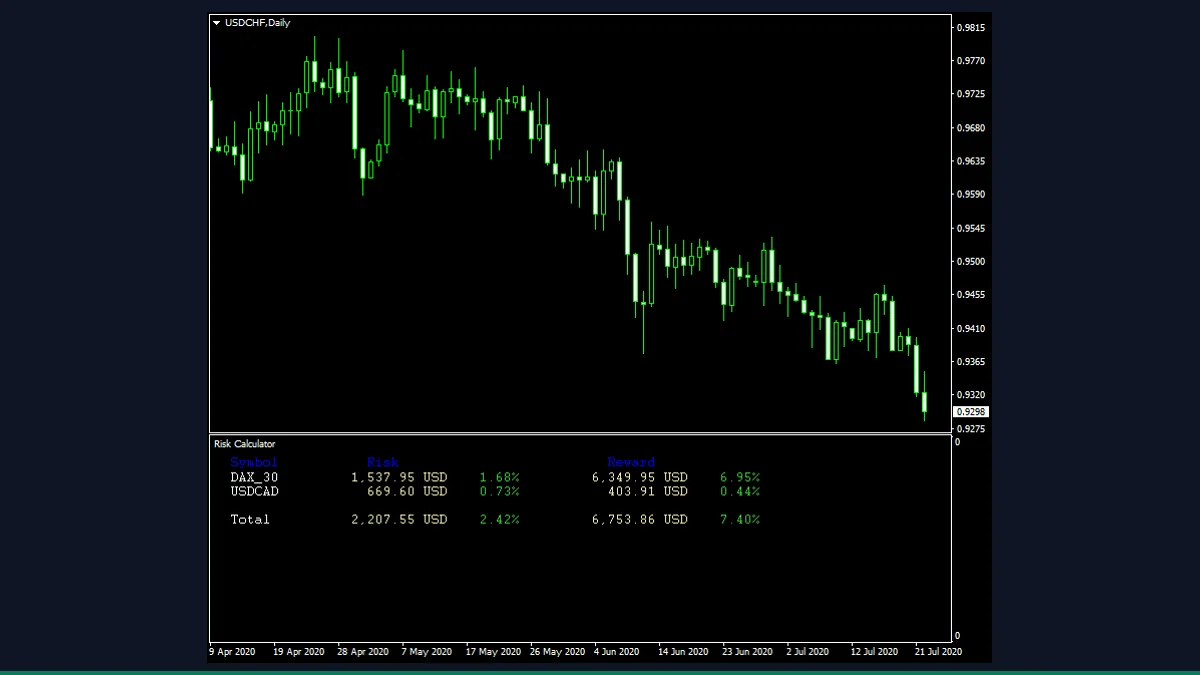
Risk Calculator
Reads your open and pending orders to show total risk and reward in both money and percent.
Trade Info Panel
An on-chart dashboard of balance, equity, floating P/L, margin and spread, all in one panel.